When your knee makes you hesitate before a step, a squat or getting out of a chair, it helps to understand what support you might need. Here is how to make sense of the pattern without trying to diagnose yourself.
Knee pain when bending can have several causes. Pain around the kneecap, tendon discomfort, osteoarthritis and an injury can all make bending uncomfortable. The movement that hurts cannot identify the cause on its own. Assessment brings together your symptoms, health history and examination to guide the next step. [1–4]
Perhaps you have started taking the stairs one at a time. Maybe you are avoiding squats at the gym, or getting down to play with your children has become something you think twice about.
It can be frustrating when a familiar movement suddenly feels uncertain. You might wonder whether to rest, keep exercising or worry about damage inside the knee.
You do not need to know the name of the problem before asking for help. At Summit, we want to understand what the pain is stopping you doing, as well as how your knee feels.
What the pattern can tell us
Where the pain is, how it began and what happens afterwards all matter. The examples below describe possible patterns, rather than a checklist for confirming a diagnosis.
More than one condition can produce similar symptoms. A painful squat does not automatically mean a torn meniscus, and pain on stairs does not automatically mean arthritis. [1–3]
Pain around or behind the kneecap
An ache around or behind the kneecap during squatting, stairs or running can fit a pattern called patellofemoral pain. Despite sometimes being called “runner’s knee”, it affects people with different activity levels. [2]
The label describes a clinical problem around the kneecap. It does not, by itself, tell you that your kneecap is out of place or that your knee needs correcting.
If this is the pattern your assessment identifies, your clinician can discuss how to adapt activities and build a suitable exercise plan. It is worth explaining which tasks matter most to you, rather than focusing only on a gym exercise you cannot currently do.
Pain just below the kneecap
More localised pain in the tendon below the kneecap, particularly with jumping or running, can fit patellar tendinopathy. This is a painful tendon condition; it should not automatically be described as simple inflammation. [4]
Tell your physiotherapist about recent changes in training or activity, including the amount, intensity and recovery time. These details help guide assessment, although an increase in activity does not prove the cause.
Aching with activity and stiffness
Osteoarthritis is one possible explanation for activity-related knee pain and stiffness. NICE supports a clinical diagnosis in people aged 45 or over with activity-related joint pain and either no morning stiffness or stiffness lasting no more than 30 minutes. All of those features need considering together. [3]
Your age or difficulty on stairs alone cannot confirm it. Prolonged stiffness, a hot swollen joint or other unusual features may need assessment for a different condition. [3]
If you do have osteoarthritis, that does not mean you must stop using your knee. Exercise adapted to your needs is a central part of recommended care. [3]
Pain after a twist fall or sudden injury
Pain that follows an injury needs a different conversation from discomfort that builds gradually. Tell your clinician how it happened, whether swelling developed and whether you can straighten the knee. [1,5]
The meniscus is cartilage inside the knee that helps distribute load. Meniscal or ligament injuries may be considered after a significant injury, but the symptoms and examination need to be assessed together. [1,5]
A knee that becomes stuck and cannot straighten needs urgent assessment. Do not try to force it straight or assume that exercises will release it. [5]
When to get medical advice first
Get advice from NHS 111 now if: [1]
- Your knee is very painful, or you cannot move it or bear weight.
- It is badly swollen or has changed shape.
- It locks, gives way or clicks painfully.
- It is red or hot and you have a high temperature or feel hot, cold or shivery.
These symptoms need assessment before a routine physiotherapy appointment. Painless clicking alone is usually normal. [1]
Arrange a GP appointment if pain is not improving within a few weeks. You can also seek advice sooner if it is affecting your life or worrying you. [1]
Why stairs and squats can feel difficult
Both activities involve bending the knee while supporting your body weight. The depth, repetitions and any added weight can change how demanding the task feels.
If your knee is uncomfortable, it can help to adjust the task temporarily. You might use a handrail on stairs, reduce squat depth or use a higher chair for sitting and standing. These are practical ways to make an activity more manageable, rather than proof that your technique was wrong.
You do not have to test the painful movement repeatedly to find out whether it still hurts. An assessment can help you decide what to keep doing, what to adapt and how to progress.
What happens during an assessment
Your appointment should start with listening. When did this begin? What makes it easier or harder? What have you changed, and what are you concerned about?
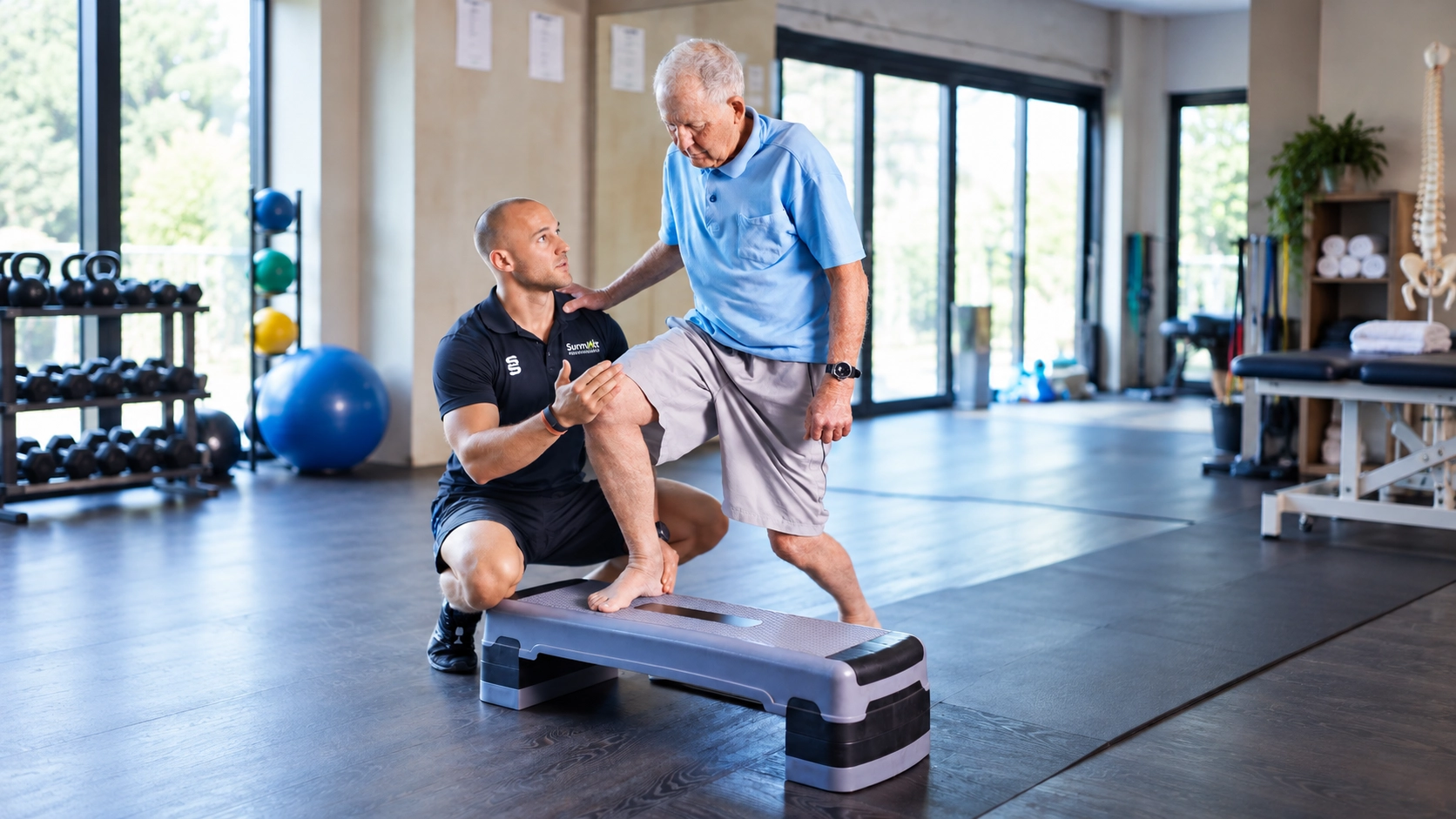
Your physiotherapist may assess bending and straightening, swelling, strength and tasks such as walking, a step or a supported squat. Further tests may be appropriate depending on your history. You should understand what each part is for and feel able to say when something is uncomfortable.
A 2024 best-practice guide for patellofemoral pain emphasises understanding the person’s experience and priorities alongside the physical assessment. Treatment should follow those findings. [2]
At Summit, we aim to explain what we find in language you understand and agree a plan with you. Sometimes the next step is physiotherapy; sometimes medical advice or further investigation is more appropriate.
What physiotherapy may offer
Treatment depends on the problem identified. It should have a clear purpose and be reviewed against your progress.
For patellofemoral pain, the 2024 guide recommends education and exercises focused on the knee, with hip exercises where appropriate. Taping, shoe inserts or other support may suit some people after assessment. Tape does not strengthen muscles and is not a replacement for rehabilitation. [2]
For knee osteoarthritis, NICE recommends tailored strengthening and general fitness exercise. Some initial discomfort can occur; your clinician should help you understand how to start and progress. If symptoms change substantially, seek a review. [3]
Your plan might work towards walking further, managing stairs or returning to training. You should know what to do between appointments, how to adjust it and when to ask for help.
Will you need a scan or surgery
Not everyone needs an MRI. UK Evidence-based Interventions guidance says most adults presenting with knee pain do not need an initial MRI once warning signs have been excluded. Significant injuries, a locked knee or ongoing catching and locking can change the need for referral and investigation. [5]
For a typical osteoarthritis presentation, NICE also advises against routine imaging unless unusual features suggest another diagnosis. [3]
A meniscal tear does not automatically mean surgery. In the five-year ESCAPE trial, exercise-based physiotherapy was no worse than surgery to remove part of the meniscus for knee function in adults aged 45–70 with degenerative tears. These were tears associated with changes over time; this finding should not be applied to every acute injury or a locked knee. [6]
If further treatment is needed, your clinician can explain the options. Needing another opinion is part of finding appropriate care.
What you can do while waiting for advice
For a newly painful knee, reduce activities that aggravate it and avoid prolonged standing. A wrapped cold pack for up to 20 minutes may help pain and swelling. Ask a pharmacist about suitable pain relief. [1]
If there are no warning symptoms, find manageable ways to stay active while adapting difficult tasks. The right exercise and amount depend on the assessment; there is no single routine for every painful knee. [2,3]
If swelling increases, the knee starts locking or giving way, or you cannot bear weight, seek medical advice rather than continuing to push the same activity. [1]
Getting back to what matters to you
You may want to climb the stairs without hesitation, enjoy a walk or feel confident getting down to the floor again. Those are useful goals to bring to an appointment.
At Summit Physiotherapy in Chorley and Wrightington, we take time to listen and build a plan around you. If knee pain when bending is affecting your day, an assessment can help you understand your options and agree the next step.
Book a Summit physiotherapy assessment
Prefer to speak to the team? Call 0800 731 2738. For the warning symptoms above, seek medical advice first.
Common questions about bending and knee pain
Does pain on stairs mean arthritis? No. Kneecap-related pain and other problems can also cause it. Your history and examination help distinguish the possibilities. [2,3]
Should I stop squatting? You may need to adapt it temporarily. Depth, repetitions and weight can be adjusted, but a locked, unstable or badly swollen knee needs assessment first.
Is clicking a sign of damage? Painless clicking is usually normal. Painful clicking, locking or giving way needs NHS 111 advice. [1]
How long will recovery take? It depends on the cause, severity and response to care. Agree review points rather than a guaranteed number of appointments.
General information for adults. It does not replace an individual assessment.